
Sweepstakes Casino Responsible Gaming Tools & Limits
 Available in US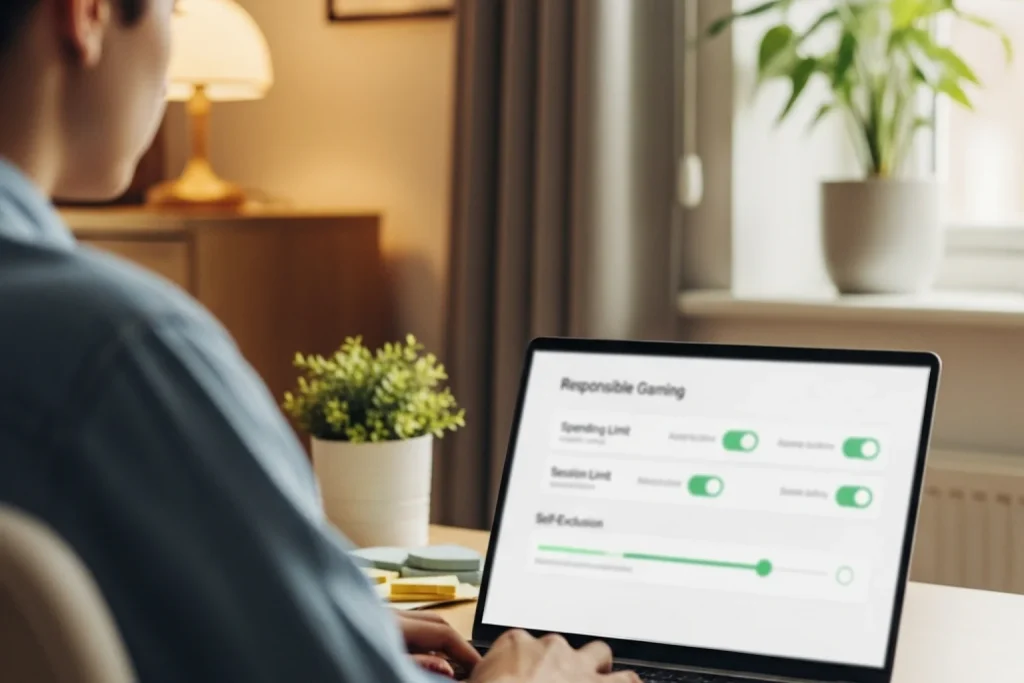
The “free to play” branding of sweepstakes casinos obscures a reality that the data makes unmistakable: the vast majority of players spend real money, and they spend it regularly. Research by the American Gaming Association found that 80% of sweepstakes casino users spend money on a monthly basis, with nearly half spending weekly, according to the AGA’s 2026 player profile report. Those aren’t the spending patterns of a free entertainment product. They’re the spending patterns of a gambling product — and they exist in an environment where the responsible gaming tools standard at licensed casinos are largely absent.
This article isn’t here to moralize about whether you should play sweepstakes casinos. It’s here to give you the tools to play them without the experience getting away from you — because the platforms themselves, for the most part, aren’t going to provide those tools for you.
Responsible Gaming Tools Available at Sweepstakes Casinos
At a licensed online casino in New Jersey, Michigan, or Pennsylvania, responsible gaming tools are mandated by law. Every platform must offer deposit limits, session time reminders, cooling-off periods, and self-exclusion options. State gaming commissions audit compliance. Players who self-exclude are blocked across all licensed operators in the state through a centralized registry.
Sweepstakes casinos have no equivalent mandate. No state requires them to offer spending controls, and no regulator checks whether the controls they do offer actually work. The result is a patchwork where some platforms have implemented voluntary RG features and others have done essentially nothing beyond a small-print link to the National Council on Problem Gambling.
Among the major platforms, Stake.us offers a voluntary self-exclusion option and allows users to set session reminders. WOW Vegas has implemented a basic deposit-limit feature that lets players cap their daily or weekly Gold Coin purchases. McLuck provides a self-exclusion mechanism through its customer support channel. Chumba Casino offers a “cool down” feature that temporarily restricts account access for a user-selected period.
What none of these platforms offer — and what every licensed casino is required to provide — is a cross-platform self-exclusion system. If you self-exclude from Chumba Casino, nothing prevents you from continuing to play on Stake.us, WOW Vegas, or any other platform. There’s no shared registry, no centralized blocking mechanism, and no way to apply a single action across all sweepstakes casinos simultaneously. The AGA’s research underscores the gap: 90% of sweepstakes casino users consider their activity to be gambling according to the AGA, yet the platforms serving those users don’t provide the gambling-specific protections that users might reasonably expect.
Signs You May Need to Step Back
Problem gambling doesn’t announce itself with a flashing warning sign. It builds gradually, and the nature of sweepstakes casinos — with their daily login loops, frequent bonus notifications, and blurred line between “free play” and real spending — can make it harder to notice the shift.
If you find yourself buying Gold Coin packages to chase a loss — spending real money to recover Sweeps Coins you lost during a session — that’s a pattern worth examining. The impulse to “get back to even” is one of the most reliable indicators of gambling behavior transitioning from entertainment to compulsion.
Watch for changes in your relationship with the daily routine. When the daily login bonus goes from a casual habit to something you feel anxious about missing — when you set alarms, rearrange your schedule, or feel irritated if you can’t access the platform — the activity has moved from passive to preoccupying.
Financial signals are the most concrete. If your sweepstakes spending has started affecting your ability to pay bills, save money, or cover essential expenses, the entertainment framework has broken down. If you’re hiding purchases from a partner or family member — not because the spending is large, but because you don’t want to explain it — that secrecy itself is a warning sign, regardless of the dollar amount.
Emotional signals matter too. If you feel a rush of euphoria after a win that’s disproportionate to the amount, or if a losing session triggers anger, anxiety, or an immediate compulsion to deposit more — the emotional cycle is mirroring patterns associated with gambling disorder. The fact that sweepstakes casinos technically aren’t “gambling” under the law doesn’t change the neurological reality of the experience.
How to Set Your Own Limits — A Practical Framework
Since most sweepstakes casinos won’t enforce limits for you, building your own framework is the practical alternative. The goal isn’t to eliminate the experience — it’s to keep it within boundaries that make sense for your financial and emotional situation.
Set a monthly budget before you start. Decide how much you can afford to spend on sweepstakes casinos per month, treating it identically to any other entertainment expense — streaming subscriptions, dining out, concert tickets. This number should be money you can lose entirely without affecting any financial obligation. Write it down. Having a specific number is more effective than a vague intention to “keep it reasonable.”
Use a dedicated payment method. Link a prepaid debit card or a separate e-wallet to your sweepstakes accounts. Load it with your monthly budget at the beginning of the month. When the card is empty, you’re done for the month. This creates a hard stop that doesn’t depend on willpower in the moment.
Set session time limits. Even if the platform doesn’t offer a built-in timer, your phone does. Set a timer for 30 or 60 minutes at the start of each session. When it goes off, close the app. This prevents the slow drift from a “quick session” into a multi-hour commitment that erodes both your balance and your schedule.
Never chase losses. If you finish a session with less SC than you started, resist the impulse to buy another Gold Coin package to recover. Close the app. The mathematical reality of any game with a house edge is that chasing losses increases total losses over time. The session that recovers everything is the exception, not the rule.
Take regular breaks. If you’ve been playing daily for more than a few weeks, take a deliberate break — a full week away from all sweepstakes platforms. If the break feels easy, your relationship with the activity is probably healthy. If it feels difficult, uncomfortable, or triggers anxiety, that’s information worth paying attention to.
Where to Get Help
If your sweepstakes casino activity has moved beyond entertainment and you’re looking for support, several resources are available — all free, all confidential.
The National Council on Problem Gambling operates a 24/7 helpline at 1-800-522-4700. They also offer live chat through their website at ncpgambling.org. For text-based support, the Crisis Text Line is available by texting HELLO to 741741. The NCPG helpline connects you with trained counselors who can provide immediate support and local referrals.
Many states also operate dedicated gambling helplines funded through gaming tax revenue. If your gambling behavior overlaps with other compulsive patterns, your primary care physician can provide referrals to specialists who address co-occurring conditions.
Gamblers Anonymous (GA) runs meetings — both in-person and online — that follow a peer-support model. The meetings are free and open to anyone who recognizes a problem. You can find local meetings through the GA website.
If you prefer a clinical approach, licensed therapists who specialize in gambling disorder can be found through your insurance provider’s directory or through Psychology Today’s therapist finder (psychologytoday.com), which allows filtering by gambling specialization. Cognitive behavioral therapy has demonstrated consistent effectiveness for gambling-related issues, and many therapists now offer virtual sessions.
Reaching out doesn’t require a crisis. If you’re noticing patterns that concern you — even mildly — talking to someone early is consistently more effective than waiting until the situation escalates.