
Gold Coins vs Sweeps Coins: Dual Currency System
 Available in US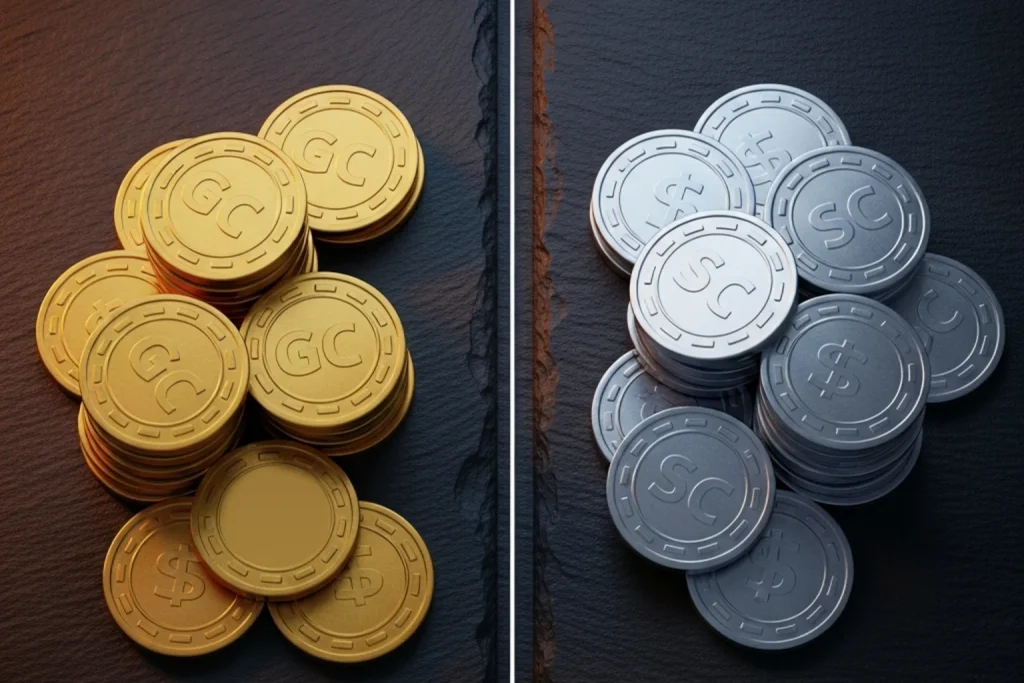
Every sweepstakes casino runs on two currencies, and confusing them is the single fastest way to misunderstand what you’re signing up for. Gold Coins and Sweeps Coins share a lobby, share the same games, and sometimes even share the same purchase screen — but they serve entirely different purposes. One is play money with no redemption path. The other is the entire reason these platforms can offer real cash prizes without holding a gambling license.
The distinction isn’t academic. It determines whether the money you spend leads anywhere or simply buys hours of entertainment with no return. It also defines the legal boundary that lets sweepstakes casinos operate in most US states while regulated online casinos remain limited to a handful. If you’re going to play on these platforms, understanding this split is not optional — it’s foundational.
Gold Coins: Understanding the Standard Play Currency
Gold Coins are the primary purchase currency on sweepstakes platforms, and this is where the money flows in. When you buy a “coin package” — say, $4.99 or $19.99 — what you’re technically buying is Gold Coins. Packages are usually denominated in large, round numbers: 10,000 GC, 50,000 GC, 200,000 GC. The numbers look impressive, but the actual dollar value of a single Gold Coin is functionally zero.
You use Gold Coins to play games in what most platforms call “standard” or “Gold Coin” mode. The gameplay is identical to the sweepstakes side — same slots, same blackjack tables, same RNG — but nothing you win in GC mode can ever be redeemed for cash. You can spin Gold Coins all day, hit a 500x jackpot in GC, and your bank account won’t change by a penny. It’s entertainment play in the purest sense, functionally identical to playing a mobile game with no prizes.
So why do Gold Coins matter at all? Because they’re the legal mechanism that makes the whole model work. The sweepstakes industry generated roughly $10 billion in gross sales during 2026, according to Eilers & Krejcik Gaming research for the Social Gaming Leadership Alliance. Those sales are Gold Coin purchases. You’re buying virtual entertainment credits, and Sweeps Coins come as a promotional bonus attached to that purchase. This framing — buying entertainment, receiving sweepstakes entries for free — is the legal scaffolding that separates the entire model from gambling.
Gold Coins are also freely distributed. Platforms hand them out through daily login bonuses, social media promotions, and community events. You’ll never run out of Gold Coins entirely, because the platform needs you to stay engaged even when you’re not spending money. Think of GC as the free chips a Las Vegas casino gives you at the door — they keep you playing, they cost the house almost nothing to distribute, and they create the illusion of abundance.
One detail new players often miss: Gold Coins and Sweeps Coins are not interchangeable. You cannot convert GC to SC, sell GC to another player, or use GC to bypass any restriction on the SC side. They exist in parallel tracks that never merge.
Sweeps Coins — The Redeemable Currency
Sweeps Coins are where the real action happens. Unlike Gold Coins, SC carry a defined redemption value — typically 1 SC equals $1 USD — and can be converted to cash prizes once you meet the platform’s requirements. This is the currency that makes sweepstakes casinos more than a social gaming app. It’s also the currency that has attracted more than 100 class-action lawsuits against operators, because it behaves so much like real-money gambling that courts in multiple states have struggled to tell the difference.
You acquire Sweeps Coins in several ways. The most common is as a bonus attached to Gold Coin purchases. When you buy a $9.99 GC package, the platform might include 3 SC as a free promotional item. You also receive small SC grants through daily logins, email verification, social media contests, and the Alternative Method of Entry — a legally mandated free pathway that usually involves sending a physical letter or filling out an online form. The AMOE route is slow and inconvenient by design, but it exists because sweepstakes law requires a “no purchase necessary” entry option.
Once you have Sweeps Coins, you can play any game on the platform in SC mode. Your wins accumulate as SC, and when you’ve met the minimum playthrough requirement — usually 1x, meaning you just need to wager the SC once — those coins become eligible for redemption. You submit a cashout request, complete identity verification if you haven’t already, and the platform processes your payout via bank transfer, PayPal, Skrill, or cryptocurrency, depending on the operator.
The operator payout ratio — the percentage of SC that actually gets returned to players as prizes — sits between 68% and 72% for major platforms, according to analysis published by RG.org. That means for every dollar’s worth of SC in circulation, players collectively get back roughly 70 cents. The rest is the operator’s margin. This isn’t dramatically different from the house edge at a regulated casino, but it’s worth understanding that the “free” framing of sweepstakes casinos still involves a mathematical advantage for the house.
Sweeps Coins also come with restrictions that Gold Coins don’t. Some SC are marked as “bonus” and carry higher playthrough requirements — 3x or 5x instead of the standard 1x. SC won through promotional events may have expiration dates. And redemption thresholds vary by platform: some let you cash out at 50 SC ($50), while others set the floor at 100 SC ($100). These details live in the terms of service and can change without notice.
Side-by-Side Comparison Table
Seeing the two currencies next to each other makes the contrast obvious. Here’s how Gold Coins and Sweeps Coins compare across every dimension that matters.
| Feature | Gold Coins | Sweeps Coins |
|---|---|---|
| How you get them | Purchase packages, daily bonuses, social promotions | Free bonus with GC purchase, daily login, AMOE, promotions |
| Cash value | None | 1 SC ≈ $1 USD at redemption |
| Can be purchased directly | Yes | No — always received as a bonus or grant |
| Redeemable for cash | No | Yes, after playthrough and KYC |
| Playthrough requirement | None | Usually 1x (higher for bonus SC) |
| Minimum cashout threshold | N/A | Varies: 50–100 SC typical |
| KYC required to use | No | No (for play); Yes (for redemption) |
| Tax implications | None | Redeemed prizes may be taxable as income |
| Convertible to the other currency | No | No |
The table reveals a pattern worth highlighting: Gold Coins are unrestricted but worthless in dollar terms, while Sweeps Coins are valuable but hedged with conditions at every step. The playthrough requirements, KYC gates, and minimum thresholds all create friction between earning SC and actually receiving money. That friction is deliberate — it keeps players engaged longer and reduces the operator’s actual payout obligations.
One more wrinkle: some platforms use different names for these currencies. Funrize calls them “Tournament Coins.” Fortune Coins labels the redeemable currency “Fortune Coins” rather than Sweeps Coins. The branding changes, but the underlying mechanics — play currency versus redeemable currency — remain the same across every legitimate sweepstakes casino operating in the US.
The Conversion Math — What 1 SC Is Actually Worth
The nominal exchange rate is simple: 1 SC redeems for $1 USD. But nominal value and effective value are two different things, and the gap between them is where most players lose track of the economics.
Start with how you acquire SC. A typical Gold Coin package priced at $9.99 might include 3 SC as a bonus. That means your effective cost per SC is $3.33 — you’re paying $3.33 in real money for something that redeems at $1.00. On the surface, that’s a losing proposition before you play a single game. The math only works in your favor if you win enough during gameplay to multiply your SC balance beyond what you paid for it.
Larger packages offer better ratios. A $49.99 package might include 25 SC, dropping the cost per SC to $2.00. First-purchase bonuses can be even more generous — some platforms offer triple SC on your initial buy, effectively bringing the cost per SC below $1.00 for that single transaction. Promotional events and seasonal sales periodically improve the ratio further.
Now factor in the house edge. If the average RTP across sweepstakes slots is roughly 94%, then for every 1 SC you wager, you can expect to get back 0.94 SC over time. Starting with 3 SC from your $9.99 purchase and playing at 94% RTP, your expected SC balance after full playthrough is about 2.82 SC — redeemable for $2.82. You spent $9.99 to get $2.82 back. That’s a net loss of $7.17, or roughly 72 cents on the dollar. The entertainment value of the playing time has to make up the difference, just as it would with any form of paid entertainment that involves an element of chance.
None of this accounts for variance, of course. A single big win can flip the math entirely, turning a $9.99 purchase into a $200 redemption. But over hundreds of sessions, the averages assert themselves. Understanding the effective cost of each Sweeps Coin — not the redemption value, but what you actually paid per coin — is the clearest way to keep expectations calibrated.