
Sweepstakes Casinos vs State Lotteries: Market Comparison
 Available in US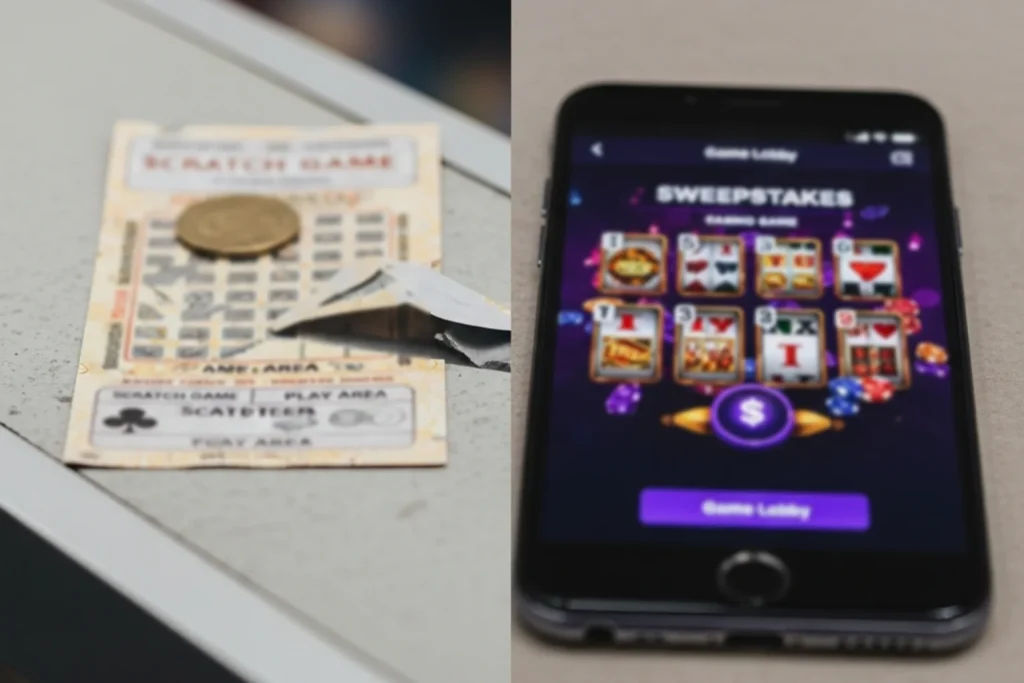
The US lottery industry posted $91 billion in sales during fiscal year 2026 — and for the first time in years, that number represented a decline. Sales dropped 5.6% year over year, according to Scientific Games’ annual sales summary. The timing of that decline coincided with the sweepstakes casino market’s most explosive growth period, and that’s not a coincidence. Both products compete for the same consumer dollars — discretionary entertainment spending from Americans who want a chance to win something — and the sweepstakes model is capturing an increasing share.
Where Consumer Spending Overlaps: Casinos vs Lotteries
The overlap between lottery players and sweepstakes casino users is larger than either industry publicly acknowledges. Both products target casual entertainment seekers who want low-barrier access to chance-based gaming. Both rely on frequent small transactions — a $2 scratch ticket, a $4.99 Gold Coin package. Both promise the possibility of a life-changing payout while generating the vast majority of their revenue from the steady accumulation of modest purchases.
The numbers illustrate the scale of the collision. US lotteries generated $91 billion in sales during FY2025. Sweepstakes casinos generated roughly $10 billion in gross sales during 2026, according to Eilers & Krejcik Gaming research reported by iGaming Business. On the surface, lotteries still dwarf sweepstakes casinos by a factor of nine. But the growth rates tell a different story: sweepstakes casinos have been expanding at a CAGR of 60 to 70% while lottery sales are contracting. If those trajectories held — and regulation is now ensuring they won’t — the gap would have closed significantly within a few years.
The consumer wallet is finite. A player who spends $50 per month on sweepstakes casino Gold Coin packages is $50 per month less likely to spend that same amount on lottery tickets. The effect is dilutive rather than additive — sweepstakes casinos aren’t creating new gambling spending; they’re redirecting existing entertainment budgets from one product to another. Lottery commissions, which depend on ticket sales to fund state education budgets, infrastructure programs, and other public services, see this as a direct threat to government revenue.
Why Lottery Commissions Are Fighting Back
State lottery commissions are not passive observers. They are among the most organized and politically connected opponents of the sweepstakes casino model, and they have both the data and the institutional relationships to drive legislative action.
Scientific Games — the largest technology provider to US state lotteries — has published multiple reports documenting the competitive dynamics between sweepstakes casinos and lottery products. A Scientific Games industry analysis highlighted Chumba Casino’s position as the market leader with approximately 50% share across 48 states, framing the sweepstakes model as a direct competitor for consumer entertainment dollars that would otherwise flow to state lottery products.
The National Association of State and Provincial Lotteries has raised concerns about sweepstakes casinos at industry conferences and in communications with state legislators. Their argument is straightforward: sweepstakes casinos offer a gambling-like experience without paying the gaming taxes that lottery operators contribute to state budgets. Every dollar diverted from lottery products to sweepstakes platforms is a dollar that doesn’t fund public schools, road maintenance, or conservation programs — depending on how the state allocates its lottery revenue.
The political alignment is powerful. Lottery commissions have pre-existing relationships with state legislators through their role as government revenue generators. When a lottery director tells a state senator that sweepstakes casinos are eroding the funding stream for education, that message carries institutional credibility that the sweepstakes industry’s lobbying efforts struggle to match. The six state bans enacted in 2026 all had some degree of lottery industry support — either through direct lobbying, data provision, or coalition-building with tribal gaming interests that share the same concern about unlicensed competition.
The tension is further intensified by the way sweepstakes casinos position themselves. Marketing campaigns for platforms like Chumba Casino and Stake.us run alongside lottery advertisements on social media and digital platforms, creating direct competitive confusion. A consumer scrolling through Facebook may see a lottery ad and a sweepstakes casino ad within the same session, both offering the chance to win prizes. The lottery ad leads to a state-regulated product. The sweepstakes ad leads to an unregulated one. Lottery commissions argue, with justification, that this dynamic undermines consumer trust in the entire gaming ecosystem.
The Player Perspective — Entertainment Value Compared
From the player’s side, sweepstakes casinos offer a fundamentally different entertainment experience than lottery products — and for many consumers, it’s a more compelling one.
Lotteries are passive. You buy a ticket, scratch it or wait for a drawing, and the experience is over in seconds or hours. There’s no gameplay, no strategy, no social interaction, and no ongoing engagement between purchases. The RTP on lottery products is typically 50 to 60% — meaning the state keeps 40 to 50 cents of every dollar sold, a house edge that makes even the lowest-RTP slot look generous.
Sweepstakes casinos offer continuous, interactive entertainment. You can play for hours on a single purchase, choose from hundreds of games, adjust your bet sizing, engage with community features, and experience the dopamine cycle of wins and losses throughout a session. The RTP on sweepstakes slots averages around 94%, according to Bettors Insider — dramatically better than lottery products. The experience is closer to a video game than a lottery ticket, and for a generation raised on interactive digital entertainment, that distinction matters.
The social element amplifies the difference. Sweepstakes platforms feature leaderboards, tournaments, daily login communities, and chat features. Buying a lottery ticket is a solitary transaction; playing a sweepstakes casino can feel like joining a community. For players who are motivated by social engagement as much as by potential winnings, sweepstakes casinos deliver a value proposition that lotteries can’t replicate with a paper ticket or a draw-based game.
Can Sweepstakes and Lotteries Coexist?
The honest answer is that coexistence is probably the long-term outcome, but not in the form either industry currently envisions. State lotteries aren’t going to disappear — they’re constitutionally embedded in many states and politically protected by the revenue they generate. Sweepstakes casinos, even under regulatory pressure, have demonstrated sufficient consumer demand that some form of the model is likely to persist, whether as independent platforms or as features within regulated lottery or iGaming ecosystems.
The most likely resolution is a mixed framework. States that ban sweepstakes casinos outright will eventually legalize iGaming through formal licensing, creating a regulated channel that captures the same consumer demand through tax-paying operators. States that don’t ban sweepstakes casinos may eventually regulate them — imposing licensing requirements, tax obligations, and consumer protection mandates that bring the model closer to the lottery’s compliance framework.
Either path leads to a version of the gaming market where sweepstakes-style products and lottery products compete on a more level playing field: both taxed, both regulated, both subject to consumer protection standards. The current conflict is driven less by the products themselves than by the asymmetry in their regulatory treatment. Level the regulatory field, and the competition becomes a consumer choice rather than a policy battle.